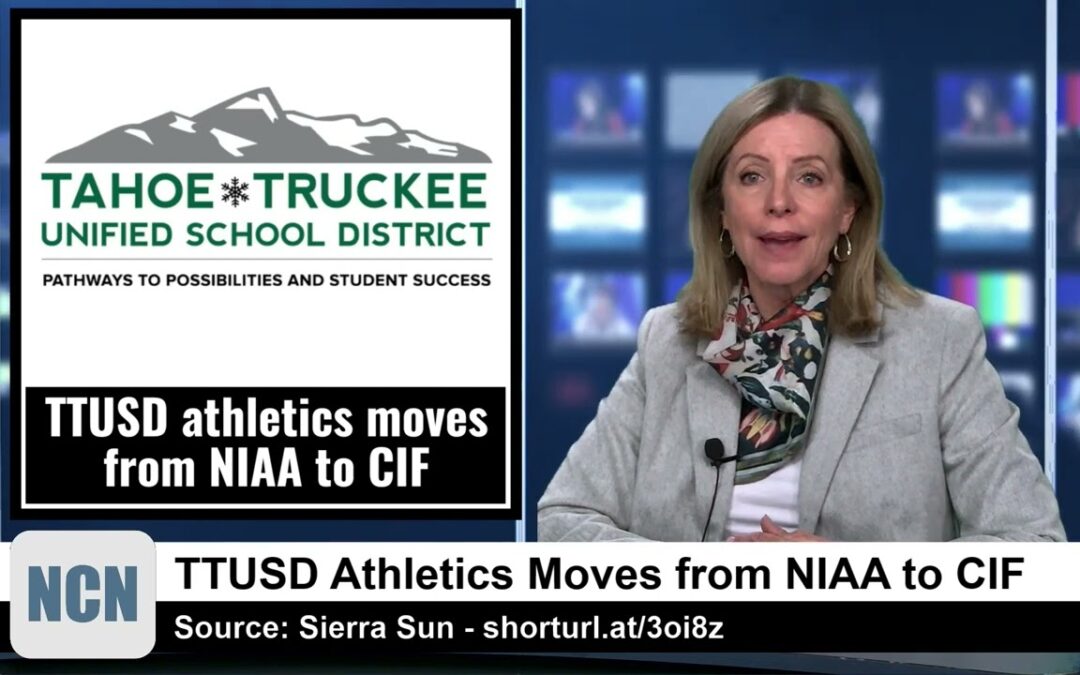
If you’ve been following local news lately, you’ve probably heard the same question popping up in conversations at the coffee shop, on neighborhood walks, and in school pickup lines: What happens next for Truckee High and North Tahoe High athletics?
Both schools, part of the Tahoe-Truckee Unified School District (TTUSD), are being required to move their athletic programs from the Nevada Interscholastic Activities Association (NIAA) to the California Interscholastic Federation (CIF). It’s a major shift, and the conversation is landing in the middle of winter, in a mountain community where travel is never a small detail.
The move could take effect as soon as the Fall 2026 sports calendar, while many concerned parents and locals are trying to delay or halt the move altogether.
Truckee and North Tahoe aren’t the only affected kids. The new leagues the schools will be placed in for the CIF will also see travel burdens outside of the winter sports seasons. During spring sports of baseball, softball, and track, Truckee often hosts “home” games at locations and fields in Reno because our fields are still covered in snow. Are teams from places like Placerville, Roseville, and Yuba City going to have to start traveling to away league games in Reno, Nevada?
What’s changing?
Since the early 1980s, TTUSD schools have competed in the NIAA, which is based in Nevada. The move now being required would shift competition to CIF, California’s governing body for high school sports.
That change impacts more than just paperwork. It can affect:
- Travel distances and travel time for games over the summit versus through Reno and out into Nevada.
- Some sports change to different seasons, with weather conflicts potentially canceling those teams altogether. (soccer and tennis both take place in the fall currently for Truckee in the NIAA)
- New overnight needs for certain matchups.
- More missed class time.
- Costs for transportation and staffing.
- Winter driving exposure for students, coaches, and families.
Why is this happening now?
The core issue is a conflict between state law and athletic association policy.
California has inclusivity requirements related to student participation, including transgender student-athlete participation. The NIAA has policies that do not align with California’s requirements. TTUSD’s long-standing participation in a Nevada league has been viewed as incompatible with California’s legal framework. The catch….Truckee and North Tahoe are not the only California schools that compete in Nevada. South Tahoe, Needles, and Coleville are also across the California border, but so far have missed the scrutiny of the CIF radar.
Importantly, this situation did not begin because a specific TTUSD student or family filed a local complaint about day-to-day athletics. It stems from a formal complaint filed with the California Department of Education (CDE) in June 2025, which triggered a state review. Public reporting indicates that the complaint originated from a party without a direct, immediate connection to a TTUSD student affected by the league arrangement.
That detail matters to many locals, not because it changes the legal reality, but because it raises a community-level question: When decisions are forced from outside the day-to-day lived experience of mountain schools, are the on-the-ground consequences being fully weighed?
The mountain reality: Travel over the summit isn’t theoretical.
In most places, changing leagues might mean a longer bus ride.
Here, it can mean repeated travel over high-elevation passes and through winter storm conditions. Anyone who has lived in Truckee long enough has seen the full range:
- Whiteout conditions.
- Chain controls.
- Spin-outs and closures.
- Multi-car accidents.
- Hours-long backups.
And it’s not just athletes on a bus. It’s also parents driving to support their kids, staff coordinating logistics, and teams returning late at night after long days.
So, it’s reasonable for the community to ask: How will increased travel demands affect student safety, fatigue, and academic time, especially in winter?
Questions worth asking (without assuming the answer)
As TTUSD, families, and community members navigate this, here are a few practical questions that can help move the conversation from frustration to problem-solving:
- What does the CIF schedule actually look like for Truckee High and North Tahoe High?
Which matchups increase travel the most, and which are comparable? - What winter travel safety standards will be required, and how will opposing teams deal with this also?
Chain readiness, driver training, storm-call decision rules, and return-time limits. - What will the academic impact be?
Missed class time, late-night returns, and student fatigue. - What will it cost, and who pays?
Transportation, staffing, potential overnight stays, and budget tradeoffs. - Are there creative alternatives that preserve safety while meeting legal requirements?
The goal isn’t to “win” an argument. It’s to keep kids safe, keep sports meaningful, and keep our community values intact.
A respectful next step
If there’s one thing Truckee does well, it’s rallying around practical realities. We can hold two truths at once:
- Our location creates unique safety risks that deserve serious consideration.
- Every student deserves dignity, belonging, and fair access to participation.
The path forward will be stronger if the conversation stays grounded in facts, focused on student well-being, and open to solutions that protect both safety and inclusion.
If you’re a parent, coach, student, or community member, consider asking TTUSD and local leaders for clear details on travel impacts and safety protocols, and consider showing up with ideas, not just concerns.
Why Choose Elements Mountain Company?
With decades of experience and a reputation for reliability, we make it easy to book the services you need—when you need them. No contracts, no property management—just top-quality work from the team Truckee homeowners trust.