
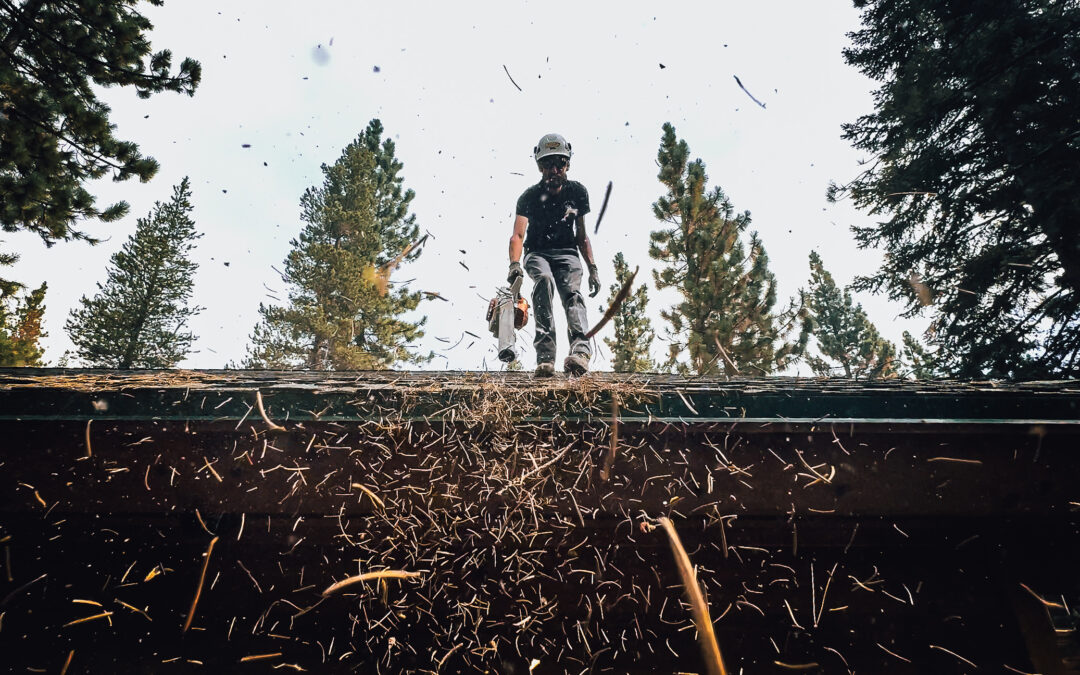
Late summer in Truckee, Tahoe Donner, and North Lake Tahoe is when pine needles start to pile up quietly, then suddenly become a problem.
Unlike broadleaf debris, needles interlock, mat down, and move differently in wind and rain. That can change how water drains off your roof, how your gutters perform, and how moisture behaves around your foundation.
Why pine needles are a different kind of debris
Pine needles tend to:
- Mat and pack tightly, especially in roof valleys and gutter corners
- Trap moisture longer than you expect, which can accelerate wear on some surfaces
- Redirect water by creating small “dams” that push runoff where it does not belong
- Hide issues like lifted shingles, rusting flashing, or sagging gutters
In late summer, you also get a specific mix of conditions that makes this worse: dry debris, gusty winds, then sudden thunderstorms.
Where pine needles cause the most trouble
Roof valleys and transitions
Valleys, dormer intersections, and roof-to-wall transitions are natural collection points.
When needles build up here, water can slow down, back up, and find edges.
Gutters and downspouts
Needles can form a dense plug at downspout inlets, gutter corners, and end caps.
They also collect in low spots where gutters have started to sag.
Decks and stair landings below rooflines
If your roof dumps water near a deck or stair landing, needle buildup can change where runoff lands.
That can increase staining, algae, and premature surface wear.
What to look for from the ground (no ladder required)
You can catch a lot without climbing.
Quick visual checks
- Overflow marks, dark streaks on fascia boards or siding below the gutter line
- Drip lines, consistent wet spots in one area after rain
- Sagging gutters, a visible dip, especially near a downspout
- Plants getting hammered, soil erosion or dead patches where water is concentrating
- Needle “ridges” on the roof, visible lines of debris sitting in valleys
After a thunderstorm
If you can, take a quick walkaround after a late-summer storm.
- Are there new piles of needles at one downspout outlet
- Do you see splashing or erosion where water is hitting hard
- Is any gutter section pouring water instead of draining
A realistic August-to-fall maintenance cadence
Every home and lot is different, but this cadence works well for many Tahoe-area properties.
Late August: baseline check
Walk the perimeter and note overflow marks and sagging.
Confirm downspouts discharge away from the foundation.
Clear obvious ground-level needle piles near drains and walkways.
September: pre-fall wind readiness
Recheck roof valleys and gutters after windy days.
Look for new debris patterns; they often repeat in the same spots.
October: before the first real storms
Make sure drainage paths are clear.
Confirm needles, gravel, or mulch do not block downspout outlets.
Common mistakes to avoid
- Only cleaning once, needles keep coming, and one cleaning can be undone by a single windy day
- Ignoring where the water goes: clean gutters are good, but discharge location matters
- Assuming staining is cosmetic, stains can be a clue that water is consistently going somewhere it should not
FAQ: quick answers for Tahoe homeowners
Do pine needles damage shingles
Needles themselves are not “acidic” in a dramatic way, but packed debris can trap moisture and hide wear.
The bigger issue is how debris changes drainage.
Why do my gutters overflow when they look clean
A downspout inlet can be plugged even if the gutter run looks clear.
Sagging gutters can also cause overflow.
How often should I check
In late summer and fall, a quick visual check every couple of weeks is reasonable.
Always check after major wind or thunderstorm events.
LET US HANDLE THE WINTER PREP EARLY!
Not sure what you’re seeing on your roofline or where your drainage is falling short? Reach out, and we’ll help you figure out next steps.