
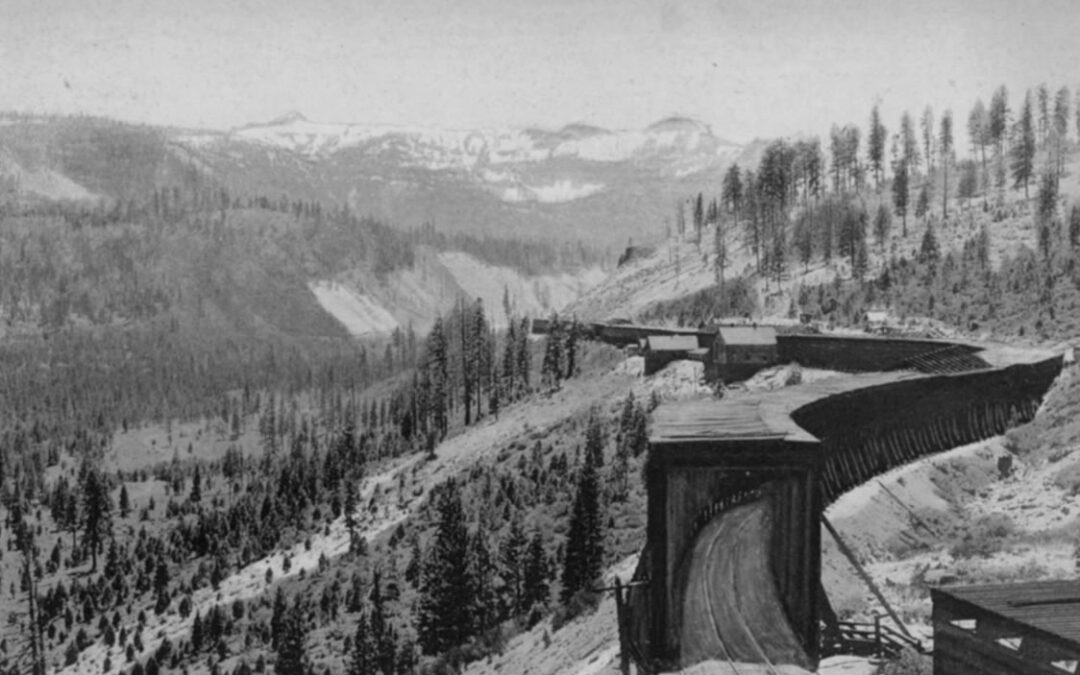
Image via Donner Summit Historical Society
If you have lived in Truckee long enough, you have probably had the same thought during a big storm, “How does anything keep moving up here?”
That question is not new. Long before ski traffic and weekend forecasts, the Sierra winter was already testing one of the most important routes in the West, the transcontinental railroad over Donner Pass. The solution that helped keep trains running through deep snow and avalanche terrain was as practical as it was impressive, the snow shed.
What is a snow shed?
A snow shed was a long, covered wooden structure built directly over railroad tracks in the most snow-prone and avalanche-exposed stretches of the Sierra. From the outside, it looked like a tunnel made of timber. From the railroad’s perspective, it was protection, insurance, and uptime.
Instead of trying to fight every drift and slide in the open, engineers created a barrier that could take the hit, keep the track clear, and let trains pass through.
Why snow sheds were built in the first place
Donner Pass is beautiful, but it is also steep, windy, and known for heavy snowfall. In the railroad era, that meant two big problems.
First, snowdrifts could bury tracks quickly, sometimes faster than crews could clear them.
Second, avalanches could sweep across the route, damaging infrastructure and shutting down travel entirely.
Snow sheds helped solve both. They reduced drifting onto the tracks, and they provided a shield where avalanches were a real threat. They were built because winter here does not negotiate. It demands planning.
How they worked (simple, but smart)
Snow sheds were designed to do a few key things well:
- Block drifting snow from piling directly on the rails.
- Protect the track from avalanche debris in exposed areas.
- Create a controlled corridor so trains could keep moving even when the weather was doing its worst.
They also required constant maintenance. Timber structures in harsh conditions need repairs, and winter always finds the weak spot. That is another Truckee truth that still applies today.
Then vs. now: the same winter, different priorities
We do not build snow sheds over driveways, but the principle is the same. In Truckee and Tahoe Donner, the people who have the easiest winters are not the ones who get lucky with storms. They are the ones who prepare for the predictable problems.
Then (railroad era):
- Keep a critical route open, no matter the storm.
- Protect infrastructure from snow load and avalanche impact.
- Maintain access for commerce and travel.
Now (modern mountain living):
- Keep your driveway accessible and safe.
- Reduce risks from snow load on decks and exterior structures.
- Stay ahead of freeze-thaw damage that turns small issues into expensive repairs.
Why snow load still matters for homeowners
Snow sheds were built because weight and accumulation create real consequences. Homeowners see the same theme in different places:
- Decks and railings take repeated stress from snow, ice, and refreeze cycles.
- Stairs and landings become slick, uneven, and hazardous when meltwater refreezes.
- Driveway edges and berms harden into ice, making access harder and driving more dangerous.
The takeaway is not to worry. It is to pay attention early, and handle issues before they grow.
Mountain living still rewards preparation
Truckee’s history is full of practical solutions to tough conditions, and snow sheds are a perfect example. They were built with one goal in mind, keep things working when the environment is demanding. That same mindset applies to homeownership here. The best time to plan spring and summer projects is before contractor calendars fill up.